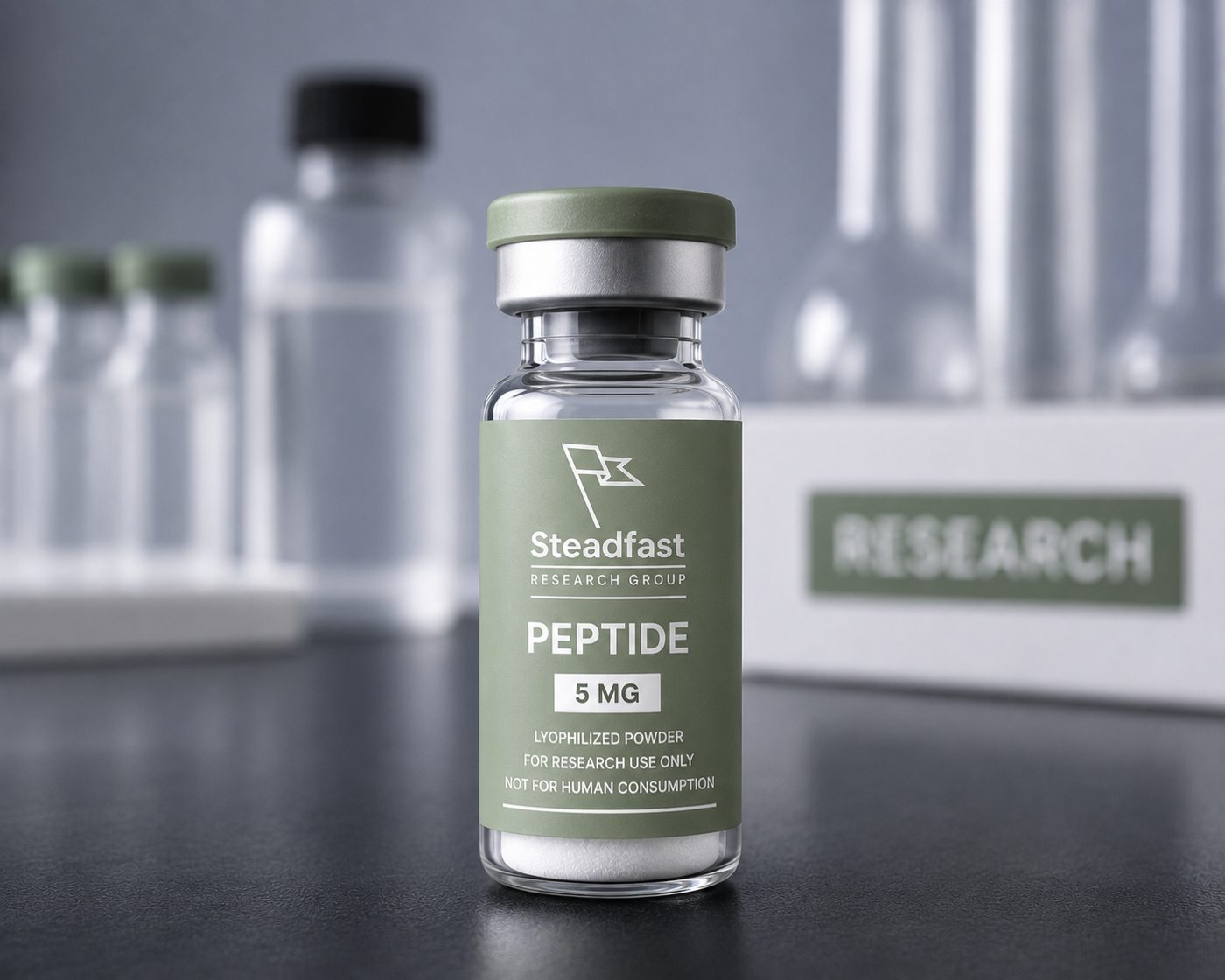
What research-grade actually means.
A plain-language guide to purity, testing, and documentation, so you can evaluate any supplier, including us, on the evidence.
Purity and why it matters
Purity describes how much of a vial's contents is the target peptide versus everything else, including synthesis by-products and residual solvents. Higher purity means fewer variables in your research. Steadfast publishes the measured purity for each batch on its Certificate of Analysis. Identity and purity are established independently of any mechanistic hypothesis about a compound — a distinction that matters when reading a literature such as the one on the mechanisms research has proposed for BPC-157, where the pathways remain unresolved, or the rodent transection work behind what tendon and ligament studies have reported about that peptide, where effect sizes vary by model, or the far older gastrointestinal studies behind the same compound, where nearly all the work traces to a single research group, or the vessel-growth assays behind what research has shown about BPC-157 and angiogenesis, where two primary studies disagree about whether there is any effect on cultured cells at all, or the receptor-pharmacology work behind tirzepatide's dual GIP/GLP-1 receptor mechanism, where reported potency shifts with the assay system used — a problem that recurs across the whole GLP-1 receptor agonist class.
Third-party testing
Independent testing is the difference between a claim and a fact — a gap that matters most for compounds where the published literature describes pharmaceutical-grade material rather than the vial in front of you, as with what research says about retatrutide. Reputable analysis uses two complementary methods:
- HPLC (high-performance liquid chromatography) measures purity by separating the sample into its components.
- Mass spectrometry confirms identity by measuring molecular mass, verifying the peptide is what the label says.
Reading a Certificate of Analysis
A Certificate of Analysis, or COA, is the lab report for a specific batch. It typically lists the compound, batch or lot number, purity percentage, the methods used, and the testing date. Match the lot number on your COA to the lot on your vial. If a supplier cannot produce one, that is your answer.
Handling and storage
General lab-handling notes for lyophilized (freeze-dried) peptides:
- Store unopened lyophilized vials cold and away from light per the product documentation.
- Once reconstituted, storage life is shorter. Keep refrigerated and follow your own protocol.
- Avoid repeated temperature cycling, which can degrade stability.
Responsible research use
These materials are sold strictly for laboratory research. By purchasing, you confirm you are a qualified researcher and that you will handle, store, and dispose of materials in accordance with applicable laws and institutional guidelines.
Guides
- How to read a Certificate of Analysis
- How to evaluate a research peptide supplier
- Storing and handling research peptides
From the Research Blog
- What Is Peptide Purity and Why Does It Matter?
- What Does Research Say About BPC-157?
- What Does 'Research Use Only' Mean for Peptides?
- What Research Says About TB-500 (Thymosin Beta-4)
- TB-500 Mechanism of Action: What Research Proposes
- Thymosin Beta-4 and Actin: What Research Reports
- What Does Research Say About GHK-Cu?
- GHK-Cu Mechanism of Action: What Research Proposes
- What Does Research Say About Semaglutide?
- Semaglutide Mechanism of Action: What Research Reports
- Semaglutide vs Tirzepatide: What the Literature Shows
- Tirzepatide Preclinical Studies: What Research Reports
- What Has Research Described About Cagrilintide?
- What Has Published Research Reported About Ipamorelin?
- What Has Published Research Reported About CJC-1295?
- What Has Published Research Reported About Sermorelin?
- What Has Published Research Reported About Tesamorelin?
- What Has Published Research Reported About Hexarelin?
- What Has Published Research Reported About GHRP-2?
- What Has Published Research Reported About GHRP-6?
- What Has Published Research Reported About MK-677?
- What Has Published Research Reported About PT-141?
- What Has Published Research Reported About Melanotan II?
- What Has Published Research Reported About Selank?
- What Has Published Research Reported About Semax?
- What Has Published Research Reported About Dihexa?
- What Are Research Peptides and How Are They Studied?
Research materials
Each page below states the compound's identity and research context and publishes its independent third-party Certificate of Analysis. Supplied for laboratory research use only.
- Retatrutide — triple GIP / GLP-1 / glucagon receptor agonist (LY3437943)
- Tirzepatide — dual GIP / GLP-1 receptor agonist (LY3298176)
- Tesamorelin — synthetic GHRH analog
- BPC-157 / TB-500 Blend — tissue-repair signalling research
- CJC-1295 / Ipamorelin Blend — GHRH analog and GH secretagogue
- KPV — alpha-MSH C-terminal tripeptide
- GHK-Cu — copper-binding tripeptide
- MOTS-c — mitochondrial-derived peptide
- SS-31 (elamipretide) — inner mitochondrial membrane tetrapeptide
- NAD+ — nicotinamide adenine dinucleotide coenzyme
- HGH — recombinant human growth hormone (somatropin)
- Bacteriostatic Water — laboratory reconstitution solvent
Have a question we did not cover? Read the FAQ or contact us.